

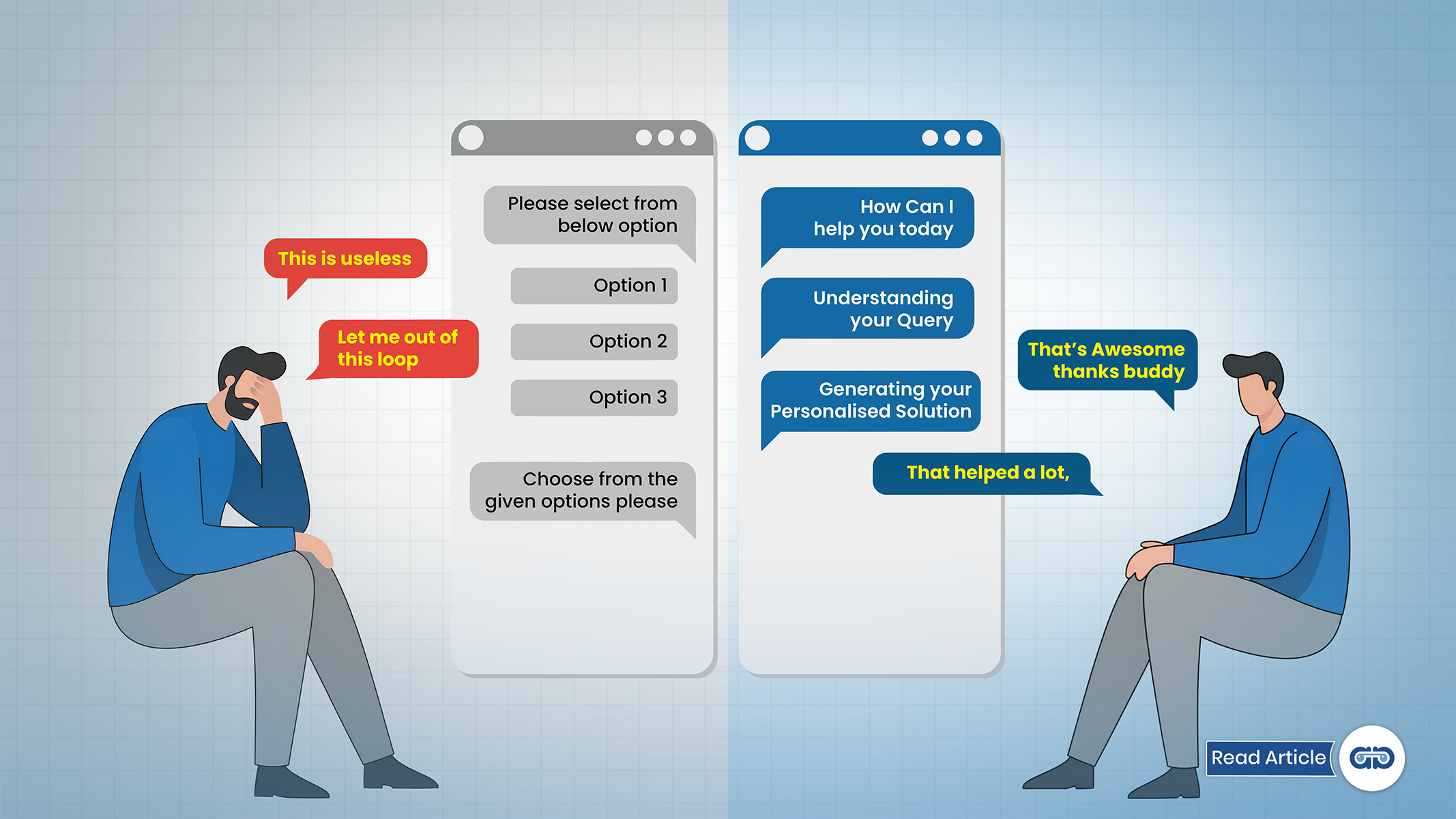
For years, chatbots were seen as a breakthrough in customer and IT support. They promised
faster responses, lower costs, and 24/7 availability. Businesses adopted them widely, hoping it would solve growing support demands. And for a while, they surely made an impact.
However, by 2026, the landscape has changed. Customers now interact daily with advanced AI tools like ChatGPT, Gemini, and others that understand context, generate insights, and adapt to conversations. This shift has raised expectations across every industry. As a result, many traditional chatbot experiences now feel slow, rigid, and frustrating rather than helpful.
The question is no longer whether businesses should automate. Instead, it is whether they are
using the right kind of automation to meet modern expectations.
How Does a Chatbot Work?
Most traditional chatbots rely on predefined workflows. They are designed to recognize specific keywords or intents and respond with scripted answers. This works well in controlled scenarios, such as FAQs or order tracking, where the possible outcomes are already mapped.
For example, suppose a customer types, “Hi, I’m moving next week and need all my future
deliveries to go to my new address.” A traditional chatbot may struggle with this request because it is built on rule-based logic and keyword matching. It is trained to recognize specific phrases such as “change address” or “update delivery address.” When the message does not exactly match these predefined intents, the system fails to understand the full context. Instead, it may present a generic menu or ask the user to rephrase the request.
This happens because many traditional chatbots rely on decision trees, intent classification, and predefined workflows. They do not truly understand language. They map inputs to scripted responses. As a result, they cannot easily interpret complex, multi-part, or conversational queries.
What Are the Major Issues With Chatbots in 2026?
Below are some limitations of traditional chatbots.
1. Conversations Often Feel Robotic
Customers can quickly tell when they are interacting with a scripted system. Even when the information is correct, the experience feels mechanical. This creates a sense that the company is prioritizing efficiency over understanding. Over time, this perception can damage trust and loyalty.
2. Context Is Still a Major Challenge
In 2026, users expect continuity. They want businesses to remember their history, previous issues, and preferences. Yet many chatbots still reset the conversation when a user rephrases a question or returns later. This forces customers to repeat themselves and increases frustration.
A modern customer experience should feel connected across channels and sessions, but traditional systems often fall short.
3. Limited Ability to Solve Complex Problems
Chatbots perform well when the problem is simple and predictable. But when the situation becomes complex, the interaction often breaks down. Customers today want automation that can diagnose, recommend, and even execute solutions. They are looking for outcomes, not just answers.
Some common areas where traditional chatbots still struggle include:
Multi-step troubleshooting
Personalized recommendations
Real-time decision-making
These limitations create a ceiling on the value chatbots can deliver.
4. Escalation Happens Too Often
One of the biggest promises of chatbot adoption was reducing the workload on human agents. In reality, many organizations still see high escalation rates. Customers often ask to speak to a human after spending time with a chatbot that did not resolve their issue.
This has two consequences. First, support teams deal with already frustrated customers. Second, operational efficiency gains remain limited.
5. The AI Expectation Gap
Perhaps the most important shift in 2026 is the gap between what customers experience elsewhere and what businesses provide. When users interact with intelligent AI tools in their daily lives, they expect the same level of capability from support systems.
When this expectation is not met, traditional chatbots feel outdated, even if they are technically functional.
Chatbot vs AI Assistant: A Detailed Comparison
Although the terms are often used interchangeably, traditional chatbots and AI assistants are fundamentally different in how they deliver value. Traditional chatbots are built around predefined scripts and workflows. They guide users through structured paths and respond based on keywords or fixed intents. This makes them useful for predictable tasks such as FAQs, password resets, or order tracking. However, when conversations become complex or dynamic, their limitations quickly appear.
AI assistants, on the other hand, are designed to understand intent rather than simply match keywords. Powered by advanced language models and automation, they can interpret context, handle follow-up questions, and adapt to different conversation styles. Instead of only providing information, they can also take action, such as retrieving data, triggering workflows, or resolving issues across integrated systems.
Another key difference lies in learning and personalization. While chatbots require manual updates to improve, AI assistants continuously learn from interactions and feedback. Over time, this enables more accurate, personalized, and proactive support.
In 2026, businesses are shifting from chatbot-driven automation to AI assistants because the focus has moved from answering queries to delivering outcomes. The goal is no longer just faster responses, but smarter and more effective problem-solving.
Is Deploying a Chatbot Still a Good Idea for Your Business?
The answer depends on how the chatbot is implemented. Simple rule-based systems still have value in handling predictable and repetitive requests. They can reduce workload in areas such as basic support, internal IT queries, or standard FAQs.
However, relying only on traditional chatbots is no longer enough. Businesses need a layered automation strategy where intelligent systems handle complex and high-impact interactions while basic automation supports routine tasks.
Organizations that adopt this approach are seeing improvements in both efficiency and customer satisfaction. The goal is not to remove human agents but to enable them to focus on conversations that require empathy, judgment, and expertise.
Conclusion
Traditional chatbots played a key role in the early stages of automation. They helped businesses manage growing demand and introduced customers to digital support. But as technology and expectations evolve, their limitations are becoming more visible.
In 2026, the focus is shifting toward intelligent, context-aware systems that can solve real problems rather than simply respond to requests. Businesses that move in this direction will not only improve operational efficiency but also deliver experiences that customers actually value.
The future of automation is not about having a chatbot. It is about building intelligent support ecosystems that combine AI, workflows, and human expertise.