

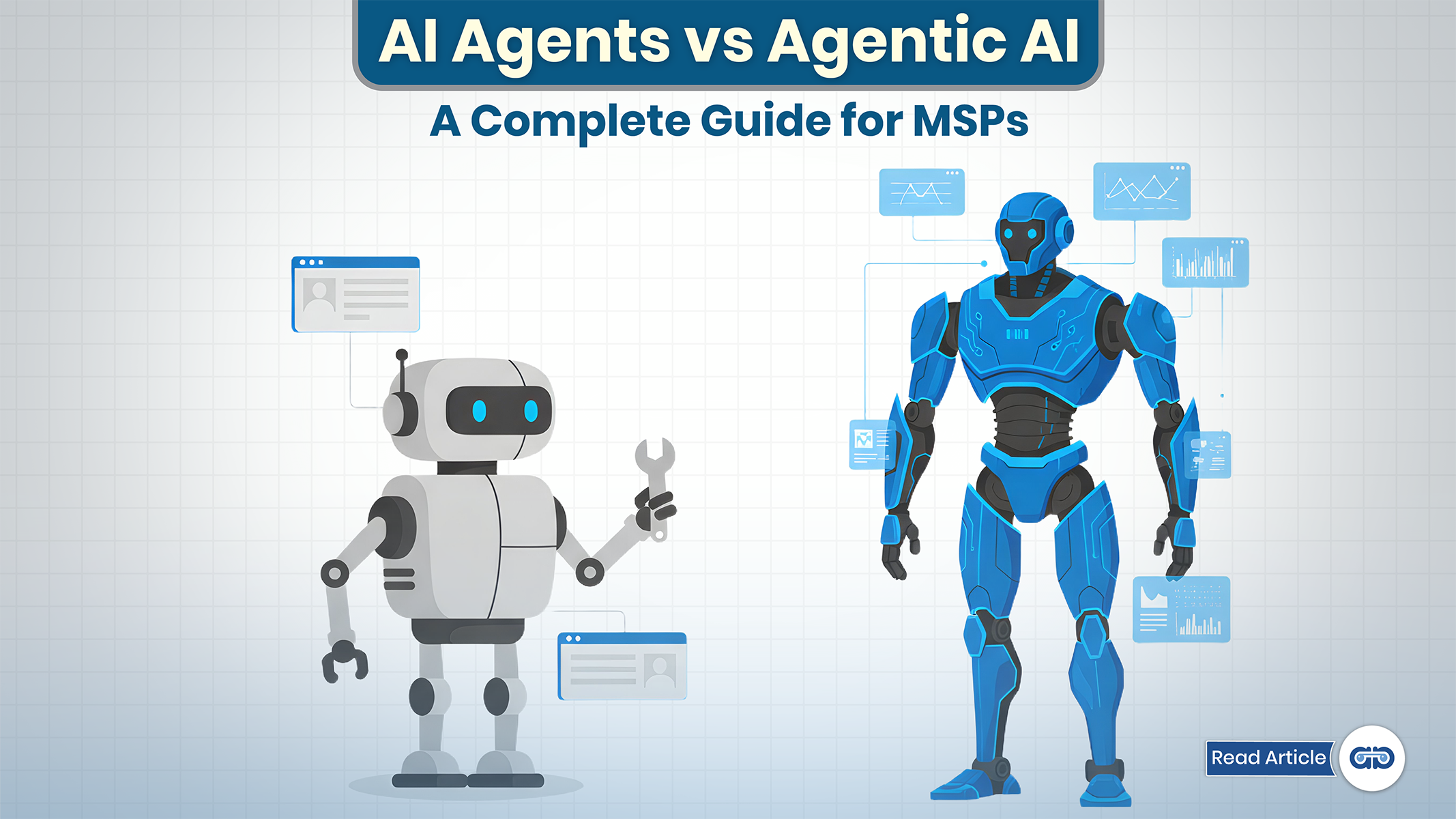
Managed Service Providers are at an inflection point. Clients expect faster resolution, smarter automation, and proactive systems that reduce downtime, and artificial intelligence is the lever. But “AI” is not a single tool. There’s a meaningful difference between AI agents and agentic AI. AI agents are basically task-focused assistants, and Agentic AI is a goal-driven, autonomous system. Choosing the right approach, or combination, will determine whether your automation strategy adds predictable efficiency or creates brittle, risky automation that breaks in the wild. This guide shows MSPs what each option really is, where each fit, and exactly how to deploy both safely and pragmatically.
What is AI Agents Vs Agentic AI
An AI agent is a software component designed to perform a defined task or set of tasks with predictable inputs and outputs. For example, a ticket-triage bot that classifies incoming incidents, or a scheduling assistant that books maintenance windows. AI agents are typically constrained. They follow rules, rely on defined APIs, and operate within explicit guardrails.
Agentic AI, by contrast, describes systems that set goals, plan multi-step strategies, and take actions with limited human supervision. Agentic systems coordinate multiple agents, adapt to changing conditions, and may invoke external tools or APIs to achieve an objective, effectively acting more like a junior operator than a single-purpose script. This distinction is increasingly recognized across major vendors and research groups.
Why the distinction matters for MSPs
For MSPs, the difference isn’t academic; it’s operational. AI agents deliver reliable productivity gains on constrained, high-volume tasks like triaging tickets, auto-remediating routine alerts, or auto-filling runbooks. They’re fast to pilot, easy to audit, and simple to roll back when they misbehave.
Agentic AI promises higher leverage. It can coordinate across monitoring, patching, vendor APIs, and customer workflows to resolve complex problems end-to-end. But with that autonomy comes risk. Agentic systems may take unexpected actions, misinterpret goals, or be vulnerable to prompt-injection and data-exfiltration scenarios if not tightly governed. Enterprises and MSPs are already seeing both the upside and security questions in live deployments.
Typical MSP Use Cases of AI Agents and Agentic AI
Use Cases of AI Agents
Automated L1 & L1.5 Ticket Handling: AI agents manage intake, classification, enrichment, and resolution for common user issues, significantly reducing manual effort and accelerating SLA-driven response times.
Routine IT Operations Automation: Agents execute standardized tasks such as password resets, software installs, patch checks, queue cleanups, and service restarts, ensuring consistent delivery across all clients.
User Lifecycle Management: Task-specific agents handle provisioning, deprovisioning, access modifications, distribution list updates, and onboarding/offboarding steps across multiple enterprise systems.
Knowledge & Documentation Updates: AI agents pull information from tickets, alerts, logs, and chats to generate or update SOPs, troubleshooting steps, and client-specific documentation on a recurring basis.
Automated Reporting: They compile service metrics, ticket summaries, compliance checks, asset inventories, and SLA dashboards, reducing administrative overhead and improving reporting accuracy.
Use Cases of Agentic AI
Autonomous Incident Resolution: Agentic AI diagnoses issues, determines the best remediation path, executes multi-step fixes, validates outcomes, and closes tickets—all without human involvement.
Proactive Monitoring & Self-Healing Systems: It continuously analyzes telemetry, predicts failures, identifies anomalies, and performs corrective actions such as restarting services, reallocating resources, or clearing stuck processes.
End-to-End Workflow Orchestration: Agentic AI executes full multi-step workflows, like onboarding flows, patch cycles, backup validation, DR drills, or environment resets, with branching logic and rollback safety.
Cross-System Decisioning & Coordination: It works across ITSM platforms, cloud consoles, identity systems, and security tools to take context-aware actions such as isolating devices, scaling infrastructure, or reconfiguring network components.
Intelligent Change Management: Agentic AI evaluates change requests, predicts impact, checks dependencies, runs pre-change validations, executes approved changes, and monitors systems post-change to ensure stability.
Autonomous Security Operations: It detects vulnerabilities, misconfigurations, endpoint threats, or abnormal behavior and performs actions such as patching, isolating assets, enforcing policies, or revoking risky user access.
Continuous Compliance Enforcement: The system scans environments for deviations from standards (ISO, SOC, CIS benchmarks) and automatically corrects drift, applies required settings, and documents compliance evidence.
Dynamic Resource Optimization: Agentic AI monitors workloads, predicts demand, and autonomously adjusts compute, storage, or licensing resources to maintain cost efficiency and performance for MSP clients.
Root Cause Analysis & Knowledge Evolution: It performs deep correlation across logs, alerts, and historical tickets to identify root causes, generate recommendations, and update runbooks or SOPs automatically.
Automated Client Health Reviews & Reporting: Agentic AI compiles operational insights, stability assessments, security posture summaries, trend analyses, and capacity forecasts to generate client-ready monthly or quarterly review packs with minimal human input.
In simple words, use AI agents where predictability and auditability are paramount. Consider agentic AI where end-to-end autonomy delivers orders-of-magnitude operational leverage, but only after you’ve matured governance and monitoring.
A Step-by-Step Pilot Strategy for Agentic AI Adoption
MSPs should adopt a staged, evidence-driven adoption path:
- Start small with AI agents: Automate narrow, high-volume tasks (ticket tagging, scripted remediations). Measure accuracy, false positives, MTTR improvements, and customer satisfaction before expanding scope.
- Hard boundaries for prototypes: Test agentic features, isolate them in a sandbox environment with synthetic data and no access to production credentials.
- Design human checkpoints: For any agentic workflow that can change configurations, modify infrastructure, or send external messages, mandate explicit human approval at well-defined decision points.
- Implement observability and auditability: Every agent action must be logged, explainable, and reversible where possible. Retain logs in a tamper-evident store and surface them in dashboards.
- Adopt “least privilege” for tool access: Grant agents only the specific API scopes they need, and rotate credentials automatically.
- Gradual increase in autonomy. Move from “suggest” to “approve” to “autonomous” after multiple successful closed-loop cycles and independent security review. Guidance from LLMops and security teams is valuable here.
How to Price, Package, and Scale AI Automation
Agentic automation can be a differentiator but it changes pricing logic. AI agents improve margin by reducing labor on repetitive tasks; agentic AI can enable higher-value SLAs (faster remediation, predictive fixes) that justify premium pricing.
Offer clear tiers that are basic automation (agent-backed) as standard, and “autonomous ops” (agentic-assisted, SLA-backed) as an add-on with strict contractual terms around responsibilities, rollback rights, and liability.
Bottom line
AI agents are an operational no-brainer for MSPs with low risk, fast ROI, and immediately helpful across the ticket lifecycle. Agentic AI is transformational potential. When engineered, governed, and monitored correctly, it can automate complex, cross-domain work, and create new premium services. But it’s not a drop-in replacement; agentic systems require discipline, security investments, and a staged rollout plan.
If you’re an MSP leader, prioritize real-world pilots that demonstrate measurable value, build the governance scaffolding first, and only graduate to broader autonomy when you can answer with evidence how you will control, observe, and recover from every possible agent action. The future is agentic; the path there should be deliberate.