

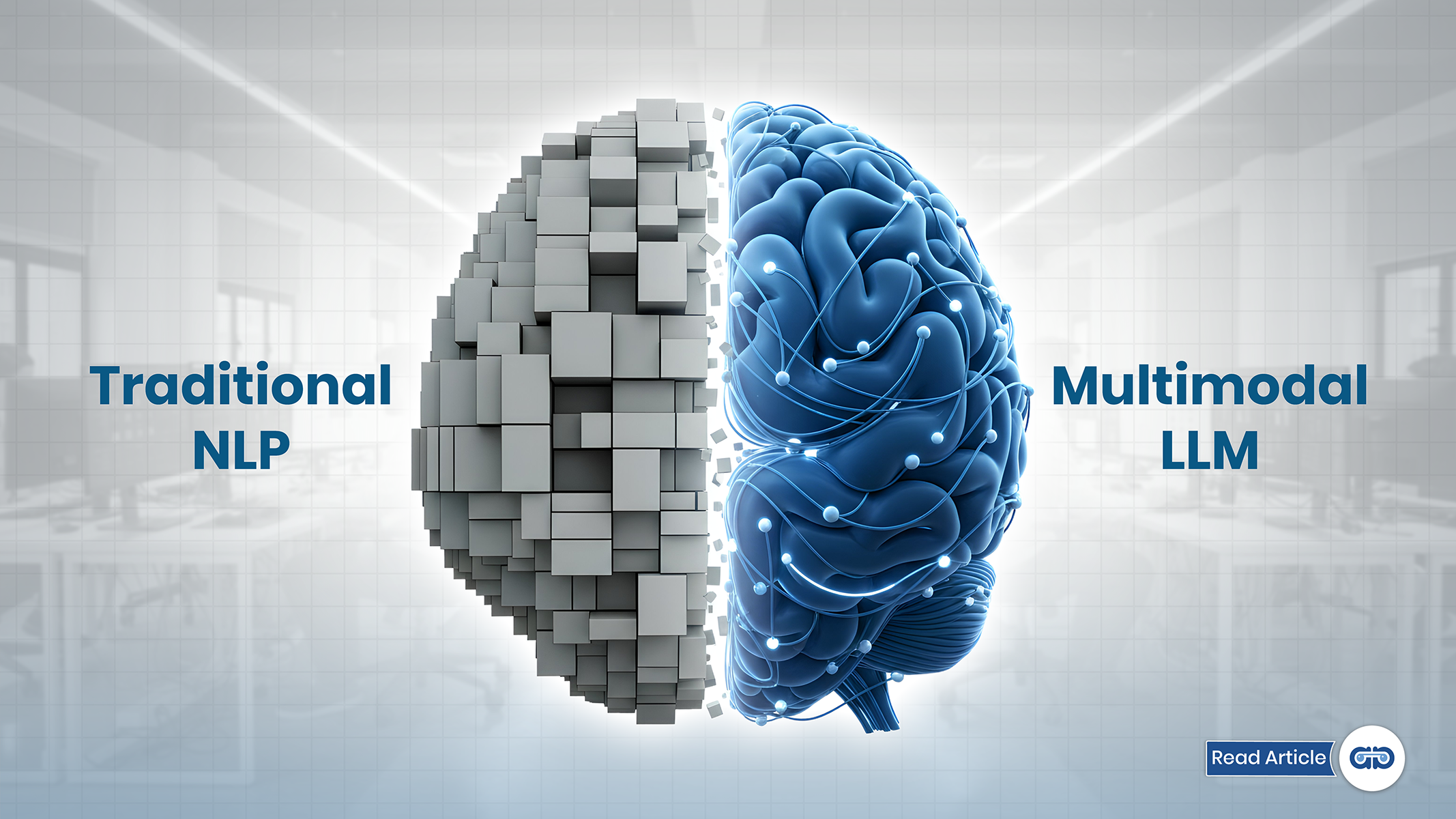
IT teams have always dealt with the messy, incomplete way people describe problems, document requirements, or write runbooks. Traditional NLP tools, meaning rule-based systems, keyword models, and narrow classifiers, were useful, but they struggled inside the complexity of real IT environments.
Large language models, instead of just parsing text, can understand context across code, logs, telemetry, and human descriptions at the same time. The result is practical, not theoretical. It ensures faster issue resolution, more reliable automation, and better visibility into knowledge that was previously buried across systems and teams.
Why IT Teams Need More Than Traditional NLP to Keep Up
Traditional NLP worked well when both the task and the input were clean and predictable, extracting an IP address from a structured ticket, classifying a predefined intent, or flagging a known keyword. But today’s IT environments are far more chaotic. Users describe issues in vague or metaphorical language; logs are huge and semi-structured, and incidents often span multiple services, configurations, and deployments.
Rule-based systems and small statistical models struggle in this reality. They need constant updates whenever formats, services, or wording change, and they fail when signals drift or new telemetry appears. Most importantly, they can’t connect clues across documents or data sources, which is essential for real incident triage. This results into inefficiency, noisy alerts, overlooked root causes, and slow escalations.
How Modern LLMs Understand Context and Ambiguity
Modern LLMs bring meaningful, practical advantages to IT workflows. Among the most important are:
- Stronger cross-artifact context: LLMs can interpret information from tickets, logs, config diffs, and other sources together in a single pass. This mirrors how human SREs reason across documents and gives teams a more unified view of what’s actually happening in a system.
- Resilience to phrasing and drift: Because they generalize well, LLMs avoid the brittleness of keyword-based systems. They understand that different descriptions, like “database lag” or “slow writes,” often point to the same issue, which cuts down on manual rule updates and makes them useful across new or changing services.
- Reasoning and synthesis: Beyond pulling out details, LLMs can outline diagnostic steps, suggest likely causes, and explain their thinking. This shifts tools from simple classifiers to assistants that actively support faster and more informed incident response. ple classifiers to assistants that actively support faster and more informed incident response.
How Modern AI Delivers Real IT Workflow Wins and Measurable Savings
LLMs are not just impressive in demos; they deliver measurable improvements across core IT workflows. Key benefits include:
- Faster incident triage and lower MTTR: LLMs can synthesize logs, commits, alert histories, and runbooks into concise summaries with likely root causes, allowing responders to focus on validation and remediation rather than time-consuming discovery. Many teams report meaningful reductions in time to resolution after integrating LLMs into their observability and incident pipelines.
- Better intent understanding in service desks: When users describe issues in non-technical language, LLMs can extract the relevant technical signals without relying on handcrafted NER rules. This leads to more accurate routing, fewer escalations, and faster first-contact resolutions, with multiple evaluations showing strong performance gains over older classification and query systems.
- Automated root-cause hypotheses: LLMs can generate ranked, evidence-backed hypotheses based on logs or telemetry. This helps engineers test the most likely fixes first. This moves teams beyond static rule-based filtering toward probabilistic reasoning that aligns closely with real-world troubleshooting workflows.
What LLMs Can Really Do for IT Operations
Success with LLMs in IT operations depends heavily on engineering discipline. Models don’t replace observability or SRE expertise; they enhance them. Key operational themes include:
- Prompt engineering and structured context: LLMs work best when they receive curated, relevant slices of logs, runbook content, and config diffs. Simply dumping large volumes of raw logs creates noise. Modern deployments rely on retrieval techniques and vector search to deliver precise, high-value context to the model.
- Observability and traceability for LLMs: Production use requires monitoring things like hallucination rates, token consumption, latency, and answer accuracy. Emerging LLMOps tooling helps teams track prompts, evaluate outputs, and make system behavior auditable rather than opaque.
- Hybrid architectures and safety guardrails: Effective systems pair LLM reasoning with deterministic checks. For example, letting the model suggest a fix but requiring automated validation before anything goes live. This preserves safety while allowing teams to benefit from the model’s speed and problem-solving capabilities.
Top Risks of Using LLMs in IT and How Pragmatic Teams Mitigate Them
LLMs do come with real risks like hallucinations, data exposure, and the balancing act between cost and latency. Most teams address these in practical, increasingly standard ways. They constrain model outputs, so they stay close to verified evidence, regularly test prompts for vulnerabilities, apply redaction or private deployments when handling sensitive information, and use human review for decisions that carry higher stakes. These measures don’t eliminate risk entirely, but they help shape it into something predictable and manageable, keeping LLMs operating within a safe and auditable workflow.
The Human Factor
Modern LLMs are reshaping IT workflows, not by replacing engineers, but by moving their work upstream. As routine, mechanical tasks get automated, teams spend more time on verification, design, and higher-value problem solving. This shift not only improves productivity but also strengthens morale, because engineers get to focus on the work that actually requires their expertise. The result is a healthier decision loop where automation handles the repetitive load and humans guide the complex judgment calls that keep systems resilient.
Final Take
Traditional NLP laid out the groundwork for automation in IT, but it was designed for smaller, more structured language tasks. Modern LLMs take that further by understanding a wider range of documents, handling messy real-world language, and generating explanations grounded in evidence. These strengths map well to the challenges IT teams face today, from navigating complex microservices to making sense of noisy observability data and vague human-written tickets. When paired with solid observability, governance, and human review, LLMs offer a realistic path to faster resolutions, stronger automation, and more resilient operations.