

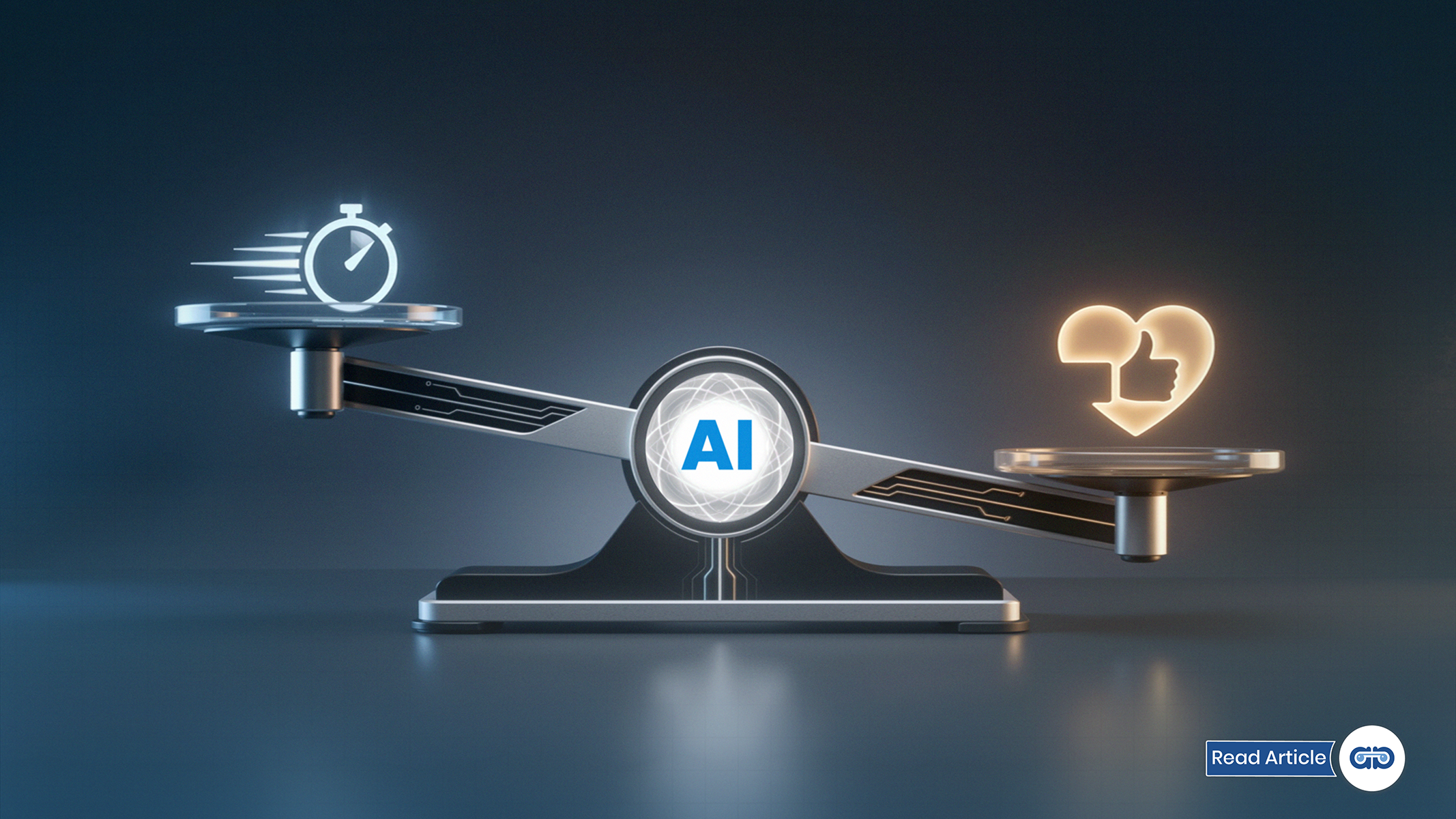
AI automation has changed what customers expect,from service. Response times have dropped from hours to seconds. Queries that once needed a human agent are now resolved automatically, any time of day across multiple channels. On paper, this looks like a big win for customer
experience (CX).
But a clear distinction is starting to emerge. There is a real difference between service that is fast and service that is genuinely good, and many organizations are still conflating the two. This gap has serious consequences for customer retention, brand trust, and revenue. Understanding it is one of the more important strategic conversations happening in digital transformation today.
Why Speed Alone Is Not a CX Strategy
Digital transformation has made speed the minimum acceptable standard in customer service. Customers no longer see fast responses as impressive. They see slow ones as a failure. This is an important shift, but it has led to a widespread misconception that deploying AI automation to speed up service is a customer experience strategy in itself.
The evidence points elsewhere. Resolution quality, personalization, and how valued customers feel are consistently stronger drivers of satisfaction than speed alone. A fast response that misunderstands the problem, ignores context, or sends someone through unnecessary steps is not good service. It is a fast failure.
Speed matters, but it is the starting point, not the finish line.
What Good Service Actually Means
Good service in the context of AI-powered customer service goes well beyond how quickly a response arrives. The qualities that actually define it are:
- Resolution accuracy: Whether the customer’s issue is fully and correctly resolved at the first point of contact.
- Contextual relevance: Using what is already known about a customer, such as their history, preferences, and previous interactions, to give them a useful, personalized response.
- Emotional intelligence: Recognizing when a situation calls for a different approach and knowing when to bring in a human agent.
- Consistency across channels: Delivering the same quality of service whether the customer is on live chat, email, voice, or any other channel.
These are the qualities that turn a routine interaction into a positive experience, and that determine whether a customer comes back.
Where AI Automation Works and Where It Struggles
When AI automation is built around customer outcomes, it can absolutely deliver both speed and quality at the same time. It can handle large volumes of routine queries accurately, free human agents for complex situations, and improve over time by learning from real interactions.
Where it tends to fall short is when it is layered over fragmented data, disconnected systems, or journeys that have not been properly thought through. In those cases, even sophisticated AI will underperform. The gap between fast and good is rarely a technology problem. It is usually a strategy and integration problem.
Some of the most common failure points in AI-driven CX include:
- Deploying automation to cut costs without mapping it to actual customer pain points
- Measuring success by volume (of tickets closed, deflection rates, etc.) rather than by outcomes like resolution rates or customer effort scores
- Building no clear path from automated service to a human agent when things get complex
- Relying on poor or siloed data that prevents AI from responding in a personalized, context-aware way
Fixing these issues is not a minor adjustment. It requires rethinking how digital transformation connects to the customer experience from end to end.
The Case for Outcome-First AI Deployment
Organizations that do customer experience well tend to start with the desired outcome and work backwards. They ask what a successful interaction looks like for the customer and then identify where AI automation can enable that. This is a fundamentally different approach from deploying technology and hoping it improves things.
The metrics that reflect this approach are different, too. First-contact resolution rates, customer effort scores, and sentiment trends give a much clearer picture of service quality than average handling time or cost per ticket. They reveal whether AI-powered customer service is actually working for the customer, not just for the operation.
This also changes where organizations invest. Rather than spending exclusively on speed-enhancing tools, the best results come from also investing in the underlying infrastructure, like clean data, integrated systems, and well-designed processes, that gives AI the foundation it needs to perform.
Human Judgement Still Has a Role to Play
A good AI automation strategy does not sideline human agents. It refocuses them. When AI handles the routine and repetitive, human agents can concentrate on the interactions that genuinely need their experience, empathy, and judgement.
This is an important reframe at a time when automation is often discussed in terms of replacement. The most effective AI-powered customer service models are the ones where AI and human agents work together, each handling what they are actually suited for.
Customers rarely think about whether they are talking to AI or a person. What they notice is whether their issue got resolved, whether they felt understood, and whether the experience was worth their time. That is the standard that matters.
Final Words
As AI automation becomes more embedded in how organizations operate, the ones that will stand out are the ones that do not mistake speed for quality. Fast service meets expectations. Good service builds loyalty, and loyalty is what drives sustainable growth.
Digital transformation, at its best, makes existing processes faster and genuinely better for the people they serve. AI has the potential to do exactly that, but only when it is deployed with the right intent, the right infrastructure, and a clear idea of what success actually looks like.